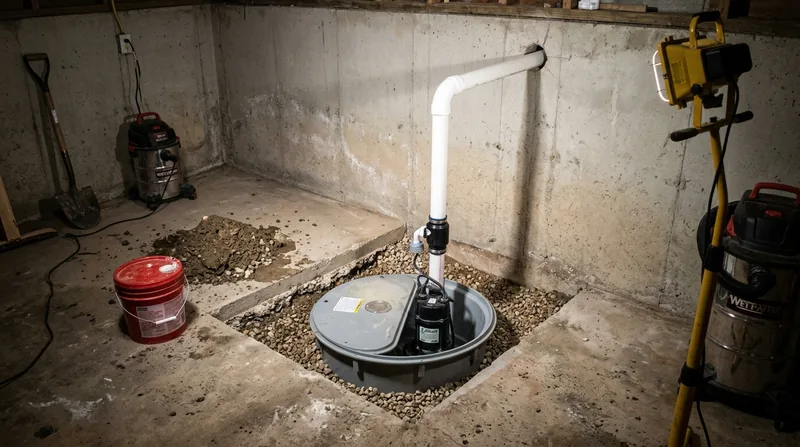




Sump Pump Installation & Replacement in Columbia
If you own a home in Columbia, you already know how fast water can show up. Deep silt loam over swelling clay subsoil sits under most of this city, and when spring thunderstorms roll through, that clay stops absorbing and starts pushing. Homes in Benton-Stephens and Old Southwest sit on fieldstone and early block foundations near the Hinkson Creek corridor, while the 1950s-1970s brick ranches around Douglass Park and Stephens Lake often have partial basements cut into the slope. In every one of those cases, the sump pump is the last line of defense, and Sump Pump Installation & Replacement in Columbia is the work we do most when the ground is saturated. A pump that is undersized, sitting in a dirt pit, or discharging two feet from the wall will lose that fight. We size the pump, seal the basin, and route the discharge so it actually keeps up. Start with a free basement inspection and we will tell you plainly whether you need a new pump or a bigger drainage fix.
Why Sump Pump Failure Hits Columbia Basements Harder Than Most
Columbia sits on clay-rich subsoil that swells when wet and cracks when dry, and that shrink-swell cycle is brutal on footing drains and old sump basins. Flat lots near Flat Branch and the Hinkson creek bottoms hold stormwater for days after a heavy rain, so a pump does not get a rest between storms. Add humid summers and freeze-thaw swings in winter, and the pump runs hard in April and sits idle in January. That is exactly the pattern that burns out motors and seizes float switches.
- Fieldstone and early block foundations in Old Hawthorne and Benton-Stephens leak through mortar joints and let silt into the basin, which clogs the pump intake.
- 1950s-1970s split-levels cut into the slope around North Central often have a shallow basin that fills faster than a 1/3 HP pump can clear it.
- Newer poured-concrete walkout basements in the Nifong Park subdivisions need a pump that can handle a sudden surge when runoff comes down the hill.
- Original discharge lines that dump water next to the foundation send it straight back into the drain tile, so the pump cycles all night.
If your pump runs constantly after a storm, the problem is usually the discharge route or the basin, not the motor itself.
Key info: A homeowner on a flat lot near Flat Branch Creek called us after his pump ran nonstop through a June storm and finally tripped the breaker. The pump was fine. The discharge line ended 18 inches from the wall, and every gallon came right back through the drain tile. We replaced the line and added a check valve, and the pump went back to cycling normally.
For the official word on what your jurisdiction requires before you alter a discharge connection, check the City of Columbia building department pages, since rules vary and must be verified locally.
How We Install and Replace a Sump Pump in Columbia
We do not drop a pump into whatever pit is already there and call it done. The basin, the pump, the check valve, and the discharge line all have to work as one system, and we look at all four before we quote anything. On older homes we often find a dirt-bottom pit that lets clay silt in, or a basin that is too small for the volume of water the footing drain delivers. On newer homes the pump is usually fine but the discharge is routed wrong.
- We inspect the existing basin, the drain tile entering it, and the discharge route, then check for water marks that show how high the water has actually risen.
- We size the pump to the drainage area and the head height, typically 1/3 to 1/2 HP for a standard residential basement, larger for walkout lots with a long run.
- We set a sealed, perforated basin with a gravel or filter fabric base so silt stays out and the pump does not short-cycle.
- We install a check valve on the discharge and route the line to a graded outlet or a dry well well away from the foundation.
- We test the float switch through a full cycle and confirm the pump clears the basin without running dry.
On a 1960s ranch in the Stephens Lake area, the original basin was a 12-inch tile crock with no lid, and the pump pulled silt on every cycle. We set a proper 18-inch sealed basin, added a check valve, and ran the discharge to a pop-up emitter 12 feet out from the wall. That is the kind of correction that ends the annual pump replacement.
If the inspection shows the pump is fine but the water is coming in through the wall, the right answer may be an interior drain tile system feeding the basin rather than a bigger pump.
Key info: In the 1990s-2020s subdivisions on the south and east edges of Columbia, we regularly find the builder-grade pump still running after 15 years with a plastic check valve that has gone brittle. We replace the pump and valve together, because a failed check valve lets water drain back into the basin and makes a healthy pump cycle twice as often.
Approaches We Use
| Approach | Description | Best for |
|---|---|---|
| Direct pump replacement | Swap the pump and check valve in an existing sound basin | Newer homes with a sealed basin and a working discharge |
| Full basin rebuild | New sealed perforated basin, gravel base, sized pump, new lid | Older fieldstone and block foundations with silt intrusion |
| Discharge line correction | Reroute the line to a graded outlet away from the wall | Pumps that cycle constantly after rain |
| High-capacity upgrade | Larger pump and basin for high inflow from the footing drain | Walkout lots and homes near the creek corridors |
Sump Pump Installation & Replacement Cost in Columbia: What to Expect
Most homeowners in Columbia are looking at a starting point around $1,200 for a straightforward pump and check valve replacement in a sound basin. That number moves up when the basin has to be rebuilt, when the discharge needs a long run or a dry well, or when the pump has to be sized for a walkout lot with heavy inflow. We do not quote a number until we have seen the basin and the discharge route, because the pump itself is rarely the whole story.
The factors that drive the price are consistent across the city. Access matters: a tight mechanical closet or a basin tucked under a stair is slower to work in than an open corner. Basin condition matters, since a dirt-bottom pit needs a full rebuild. Discharge length and outlet type matter, especially on sloped lots where the line has to run further to reach grade. And urgency matters, because an emergency call during a storm carries a different schedule than a planned replacement.
Getting two or three estimates is smart on any job of this size. Ask each contractor whether the quote covers the basin and the check valve or just the pump, and whether the discharge route is included. You can see our full breakdown on the pricing page before anyone comes out.
Sump Pump Installation & Replacement Near Me: How to Choose a Contractor Near Columbia
Hiring for below-grade work is different from hiring for a cosmetic trade, because a bad install shows up as a wet basement months later. Use the same checklist you would for any licensed trade, and do not skip the part about permits. A sump discharge that ties into the sanitary sewer or alters site drainage may need a permit, and the requirements vary by jurisdiction, so the contractor should know to check with the local building department rather than guess.
- Confirm the contractor is licensed and insured and ask for a certificate of insurance before work starts.
- Get two or three written estimates that specify the pump model, basin size, check valve, and discharge route.
- Ask for references from jobs in Columbia, ideally in neighborhoods with similar foundation types to yours.
- Ask who pulls any required permit and whether the discharge connection needs one.
- Check HOA rules in the newer subdivisions before you change where the discharge outlet sits.
A contractor who cannot answer the discharge and permit questions plainly is not the one to hire. You can reach us through the contact page to set up a free inspection.
Key info: One thing to ask about on older homes in Ashland and Centralia: whether the existing basin has a sealed lid. An open basin lets humid summer air into the basement and gives moisture a free path, and sealing it is a small addition to the job.
If you want a second layer of protection for storm season, ask about a battery backup sump pump while we are already in the basin. It is the cheapest insurance against the pump you have.
Sump Pump Installation & Replacement in Columbia: Pricing Guide
| Service | Price | Details |
|---|---|---|
| Pump and check valve replacement | Starting at $1,200 | New pump, check valve, and full cycle test in an existing sound basin |
| Full basin rebuild with new pump | Starting at $1,850 | Sealed perforated basin, gravel base, sized pump, and lid included |
| Discharge line correction | Starting at $450 | Reroute line to a graded outlet or dry well away from the wall |
| High-capacity upgrade for walkout lots | On estimate | Larger pump and basin sized to footing drain inflow, needs on-site look |
| Travel | Included | In Columbia and surrounding areas, no separate call-out or mileage fee |
| Estimate | Free | Response within 24h at (573) 818-2013, no obligation to book |
Indicative pricing, the exact cost depends on square footage, finish, and site access. Free personalized estimate within 24h at (573) 818-2013.


