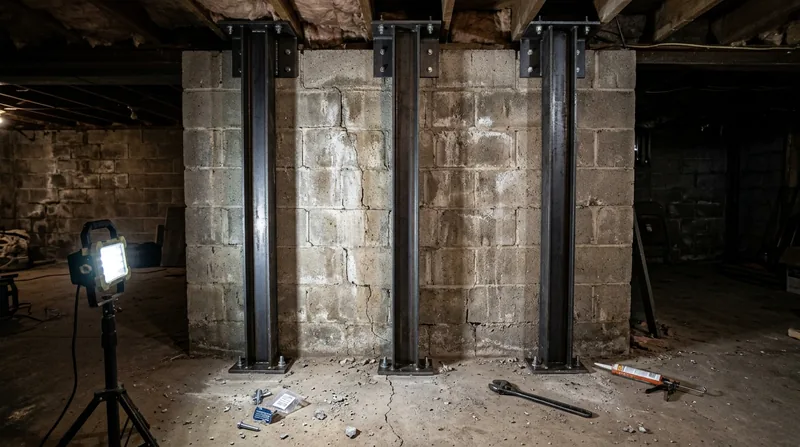




Bowing Wall Repair in Columbia: Stop the Movement Before It Gets Worse
If you live in a 1920s brick house in Benton-Stephens or Old Southwest, or a 1960s ranch in North Central, you may have noticed a basement wall that leans inward, a horizontal crack running along the block, or a floor that feels out of level. Bowing Wall Repair in Columbia addresses the cause, not just the symptom: saturated glacial clay soil pressing against older fieldstone, block, or poured walls. Our team specializes in stabilizing leaning and bowing foundation walls with carbon fiber straps, steel I-beams, and wall anchors, matched to the severity of the movement and the soil on your lot. We work exclusively below grade on residential properties, and we tell you plainly when a wall needs stabilization and when a crack is the real issue. For a broader look at how wall movement fits into the whole foundation picture, see our foundation waterproofing service.
Why Bowing Walls Are Common in Columbia's Older Basements
Columbia sits on deep silt loam over clay-rich subsoil that swells when wet and cracks when dry. Add heavy spring thunderstorms, flash runoff down the hills toward downtown, and flat lots near Hinkson and Flat Branch creeks that hold water after storms, and you get the classic setup for hydrostatic pressure against a basement wall. The 1900s-1940s brick and frame houses in Benton-Stephens, Old Southwest, and Old Hawthorne often have full basements of fieldstone or early block that were never designed for today's water loads. The 1950s-1970s brick ranches and split-levels across North Central, Douglass Park, and the Stephens Lake area have partial or daylight basements cut into the slope, and those walls take pressure from the uphill side. Even some 1990s-2020s poured-concrete basements in Nifong Park and the south and east edges can bow when the footing drain clogs and clay stays saturated.
What we see most often:
- Horizontal cracks in block or poured walls, usually at mid-height, where the wall is bending inward under soil pressure.
- Stair-step cracking along mortar joints in older block, often with efflorescence (the white mineral stain) showing where water has been moving through.
- Inward lean at the top of the wall, sometimes with a gap opening between the wall and the floor joists.
- Doors and windows that stick on the main floor above the affected wall.
- Previous patching that has cracked again, a sign the movement is still active.
If you see any of these, the wall is telling you the soil load is winning. Stabilization is the answer, not another coat of sealer.
Key info: A homeowner in Old Southwest called us after noticing a horizontal crack in a 1930s block wall and a sticking door on the main floor. The wall had moved about 1.5 inches over two wet springs. Carbon fiber straps on the interior stopped the movement without excavating the mature shade trees in the front yard.
Permits for structural foundation repair are commonly required in Columbia, and thresholds vary by jurisdiction. Always confirm with the City of Columbia Building and Site Development division before work begins: Columbia Building and Site Development.
How We Stabilize a Bowing Wall in Columbia
Every wall is different, so we start by finding out what is actually moving and why. A fieldstone wall in Old Hawthorne behaves differently from a poured wall in a Nifong Park walkout, and the fix has to match. Here is the sequence we follow on a typical bowing wall job:
- We inspect the wall from inside the basement and check the exterior grade, downspouts, and any visible footing drain issues.
- We measure the amount and direction of movement and note crack patterns, then explain what we found in plain terms.
- We recommend the method that fits the severity: carbon fiber straps for moderate movement, steel I-beams for heavier loads, or wall anchors when the exterior is accessible and the soil load is high.
- We address the water source first where needed, because stabilizing a wall while clay stays saturated is a short-term fix.
- We install the system, torque or tension it to spec, and document the before-and-after measurements.
The goal is to stop the movement, not to straighten the wall back to plumb, which is rarely necessary and often risks more damage.
Key info: A 1960s split-level in the Stephens Lake area had a block wall leaning about 2 inches at the top. We installed steel I-beams on 4-foot centers, tied them into the floor system, and added a interior drain tile system to relieve the hydrostatic pressure that caused the movement in the first place.
Repair Methods We Use
| Approach | Description | Best for |
|---|---|---|
| Carbon fiber straps | High-strength straps bonded to the interior wall and anchored top and bottom to resist inward movement. | Moderate bowing in block or poured walls with limited access. |
| Steel I-beams | Vertical steel beams set against the wall and tied into the floor and joists to carry the load. | Heavier movement or walls where straps alone are not enough. |
| Wall anchors | Exterior anchor plates connected through the wall to interior plates, tensioned to pull the wall back. | Walls with accessible exterior and significant soil pressure. |
| Drainage correction | Relieving hydrostatic pressure with interior drain tile, sump, and grading fixes before or alongside stabilization. | Walls that move only after wet weather or where clay stays saturated. |
Bowing Wall Repair Cost in Columbia: What to Expect
Pricing for bowing wall repair depends on how far the wall has moved, how long the affected section runs, and which method fits. A single wall with moderate movement may take carbon fiber straps; a longer wall or heavier load may need steel I-beams or wall anchors. Access matters too: a basement with a finished ceiling and tight clearance takes more labor than an open one. As a starting point, expect projects from $600 for minor stabilization, with most full wall repairs running higher depending on the system and footage.
Factors that move the number:
- The length of the wall and the number of straps, beams, or anchors required.
- The severity of movement and whether the floor system needs to be tied in.
- Whether drainage work is needed to relieve hydrostatic pressure.
- Access to the basement and the exterior, including finished walls and landscaping.
Getting two or three estimates is smart, and we encourage it. A contractor who cannot explain why a wall is moving, or who quotes without measuring the movement, is not giving you a real number. See our full pricing overview for a detailed breakdown of what each approach includes.
Bowing Wall Repair Near Me: What to Look for When Hiring
Hiring a contractor for structural wall repair is not the same as hiring a painter. You want someone who works below grade on residential foundations, who can explain the difference between a crack that needs sealing and a wall that needs stabilization, and who will put the scope in writing. Here is what to check before you sign.
- Licensed and insured: ask for the certificate and confirm the coverage is current.
- Multiple estimates: get two or three, and compare the method and the measurements, not just the price.
- References: ask for recent jobs in Columbia, especially older brick and block basements similar to yours.
- Permits: structural foundation repair commonly requires a permit, so confirm who pulls it and that the work will be inspected.
- Written scope: the proposal should state the method, the footage, and what happens if movement is found during the job.
We are happy to walk you through what we find and put a free estimate in writing. Reach out through our contact page to schedule a visit.
Key info: We serve Columbia and the surrounding towns, including Ashland, Hallsville, Fulton, Centralia, Boonville, Jefferson City, and Mexico. If you are in one of those areas and see a leaning wall, call (573) 818-2013 and we will take a look.
Bowing Wall Repair in Columbia: Pricing Guide
| Service | Price | Details |
|---|---|---|
| Minor wall stabilization | Starting at $600 | Covers small sections with limited movement, including site evaluation and basic carbon fiber strap installation. |
| Carbon fiber strap system | Starting at $1,200 | Multiple straps along a bowing block or poured wall, priced by the linear foot and number of straps. |
| Steel I-beam reinforcement | Starting at $2,500 | Heavy-duty beams tied into the floor system, priced by beam count, wall length, and basement access. |
| Wall anchor system | Starting at $3,500 | Exterior anchor plates and interior tensioning, priced by wall length and exterior access conditions. |
| Complex or large-scale job | On estimate | Multi-wall movement, finished basements, or combined drainage work needs an on-site look before pricing. |
| Estimate | Free | Response within 24 hours at (573) 818-2013, with a written scope and no obligation to book. |
Indicative pricing, the exact cost depends on square footage, finish, and site access. Free personalized estimate within 24h at (573) 818-2013.


