



Columbia sits on deep silt loam over clay-rich subsoil, and that clay swells every wet spring and shrinks through dry summers. That constant movement is why so many basements in Benton-Stephens, Old Southwest, and the older blocks off the Hinkson Creek corridor show cracks. If you are searching for Foundation Crack Repair in Columbia, you want a specialist who reads the crack before touching it, not a contractor who slaps hydraulic cement over everything and moves on. We inspect the wall, the soil, and the drainage around the house, then match the repair to the actual failure. Some cracks only need epoxy injection. Others are a symptom of hydrostatic pressure that no surface patch will fix. Our foundation waterproofing approach starts with that diagnosis.
Why Foundation Cracks Show Up Differently in Columbia's Clay Soil
The dominant failure here is shrink-swell clay, not coastal groundwater. Fields of 1900s fieldstone and early block walls in Old Hawthorne crack along the mortar joints as the soil pulls away in late summer. The 1950s and 1960s brick ranches across North Central and the Stephens Lake area often have partial basements cut into the slope, and those walls take uneven pressure on the uphill side. Newer poured walls in Nifong Park and the south subdivisions crack at the shrinkage joints and around tie holes.
- Vertical hairline cracks in poured walls usually point to concrete shrinkage and are good candidates for epoxy injection.
- Diagonal cracks near the corners of older block walls often signal settlement or a footing that has moved.
- Horizontal cracks, bowing, or inward lean mean the wall is under load and needs structural repair, not sealing.
- White efflorescence or damp streaks after a storm mean water is already moving through the wall.
Reading those patterns correctly is the whole job, and it is why we never quote a crack repair before seeing the wall in person.
Key info: A homeowner in Old Southwest called about a damp stripe under a basement window. The crack was a vertical shrinkage crack, but the real problem was a downspout dumping against the wall. We injected the crack and extended the downspout, and the wall stayed dry through the next spring storms.
For the official position on structural repair permits, check the City of Columbia building department before any work that alters the foundation: City of Columbia, Missouri.
How We Repair Foundation Cracks in Columbia Homes
Every repair starts with a walk of the basement and the exterior grade. We map the crack, check for movement, look at the drain tile and footing drain if they are accessible, and test whether water is pushing in under hydrostatic pressure. Only then do we choose the method. If the crack is structural or the wall is bowing, we say so and route you to the right repair rather than injecting a wall that needs bowing wall repair.
- We inspect the crack width, direction, and moisture, and check the grading and downspouts around the foundation.
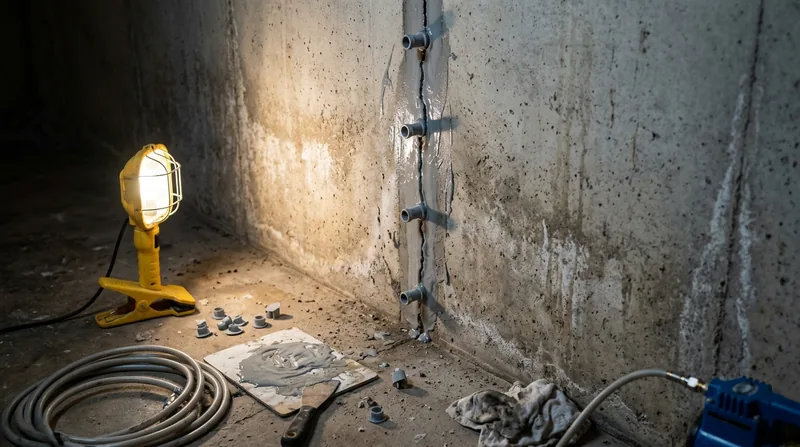
- We clean the crack and set injection ports at the correct spacing for the wall material.
- We inject epoxy for structural cracks or polyurethane for active leaks that need to flex with the wall.
- We seal the surface, remove the ports, and confirm the repair holds before we leave.
- We tell you plainly if the crack is a drainage symptom and recommend the right fix, which may be an interior perimeter drain rather than another injection.
That last step matters most, because sealing a crack while the water table keeps pushing is a temporary win at best.
Key info: A split-level in the Douglass Park area had a wet corner every time Flat Branch creek rose after a storm. The crack was minor. The water was coming up through the floor joint, so we recommended an interior drain tile system instead of repeated injections.
Matching the Repair Method to the Crack
There is no single right repair for every wall. The table below shows how we decide, and it is the same logic we use whether the house is a 1920s fieldstone foundation or a 2015 walkout in the south subdivisions.
| Approach | Description | Best for |
|---|---|---|
| Epoxy injection | Structural-grade epoxy bonds the crack faces and restores wall strength. | Non-structural vertical cracks in poured walls that are not actively leaking. |
| Polyurethane injection | Flexible foam expands into the crack and stops active water. | Active leaks in block or poured walls, and cracks that move with the seasons. |
| Crack stitching and carbon fiber straps | Reinforcement across the crack or along the wall to resist further movement. | Wider cracks, settlement cracks, and walls starting to bow. |
| Parging and wall sealing | Surface repair and sealing to close porous block and mortar joints. | Damp walls and efflorescence without a structural crack. |
| Drainage correction | Interior drain tile, grading, and downspout extensions to relieve pressure. | Cracks that keep returning because water is still pushing against the wall. |
If the inspection shows the water is the driver, we will tell you that the crack repair alone is not the answer.
Foundation Crack Repair Cost in Columbia: What to Expect
Most single-crack injections in Columbia start at From $450, and that figure covers a straightforward vertical crack with good access. The price climbs with wall thickness, crack length, the number of injection ports, and whether the crack is active. A bowing wall or a settlement crack that needs stitching or carbon fiber is a different scope and gets an on-site number.
- Crack width and length drive the number of ports and the amount of material.
- Block walls take more material than poured walls because the crack runs through the cores.
- Access matters: a finished basement wall or a tight window well adds labor.
- Active leaks and hydrostatic pressure may call for polyurethane plus a drainage fix, not injection alone.
- Structural repairs like stitching or straps are quoted after inspection, never over the phone.
Get two or three written estimates and compare the method, not just the price, because a cheap patch over a moving wall is money spent twice. Our full pricing overview lays out the ranges we work from.
Choosing a Foundation Crack Repair Contractor Near Me in Columbia
You want a contractor who will show you the crack, explain the method, and put the scope in writing. Ask for proof of licensing and insurance before work starts, and get a certificate of insurance sent directly from the carrier. Check references from jobs in your part of town, especially older homes with the same wall type. Confirm who pulls any permit the City of Columbia requires for structural repair, and ask whether your neighborhood or HOA has rules about exterior work and access. A good contractor answers those questions without pressure.
We are a basement waterproofing specialist, not a general foundation firm or a plumber, so we stay on the below-grade problem and tell you when another trade is the right call. Reach out through our contact page to set up an inspection and get a straight answer on what your crack actually needs.
Foundation Crack Repair in Columbia: Pricing Guide
| Service | Price | Details |
|---|---|---|
| Single crack epoxy injection | Starting at $450 | Includes crack prep, ports, epoxy injection, and surface sealing on one accessible poured wall crack. |
| Active leak polyurethane injection | Starting at $550 | Flexible foam injection for a leaking crack; price moves with crack length and number of ports. |
| Block wall crack injection | Starting at $650 | Higher material volume through block cores; cost rises with wall thickness and crack length. |
| Structural crack stitching or carbon fiber | On estimate | Needs an on-site look to confirm wall movement, crack width, and the right reinforcement layout. |
| Travel | Included | In Columbia and surrounding areas, no separate call-out or mileage fee. |
| Estimate | Free | Response within 24h at (573) 818-2013, no obligation to book. |
Indicative pricing, the exact cost depends on square footage, finish, and site access. Free personalized estimate within 24h at (573) 818-2013.


